 Ultimate guide
What to Expect From Pizza Delivery: A Complete Guide
Last Updated: November 19, 2026
Quick Summary
Pizza delivery typically moves through four stages: order confirmation, kitchen preparation, driver dispatch and drop-off. Each stage has its own timing, and an estimated arrival time is a window rather than an exact promise. Checking your order details at confirmation prevents most problems before the pizza leaves the kitchen.
- Check your order confirmation for items, sizes, crust choice and special notes before you leave.
- Hot food should be held at or above 135°F in transit, and cold food at or below 41°F.
- Treat the estimated arrival time as a window, and check the status before calling if it passes.
- Text the driver for arrival and drop-off instructions, and call only for a genuine blocker.
- Tip in dollars for small or distant orders, since percentages undervalue the driver's time and vehicle cost.
Table of Contents
- How the Pizza Delivery Process Works, Step by Step
- Food Safety Rules for Pizza Delivery: Temperatures and Timing
- How Long Pizza Delivery Takes and What Affects the Wait
- Pizza Delivery Tip Calculator: What to Pay and Why
- Pizza Delivery Etiquette for Customers
- What to Do If Your Pizza Order Goes Wrong
- Placing Your Next Wana Pizza Delivery Order
- Frequently Asked Questions
How the Pizza Delivery Process Works, Step by Step
Most people who order pizza for delivery know the basics, but the details between the click and the doorbell are where expectations go wrong. At Wana Pizza, we've watched that gap play out for years.
The 2026 Pizza Delivery and Carryout (DELCO) benchmark report analyzed 600 mystery shop orders across large and mid-size chains, and found that speed is no longer the primary driver of customer satisfaction.
From Placing Your Order to Confirmation
Your order starts the moment you submit it, whether online, through an app or by phone. A good confirmation tells you the items, sizes, crust choice and any modifications, so take a minute to check it before you walk away.
Pay attention to special instructions. If someone in your household needs a gluten-free crust or a plain cheese pie, confirm it appears on the ticket.
Tracking Your Driver and Estimated Arrival Time
Once the pizza is in the oven and out the door, tracking becomes the main way to follow your order. Many ordering systems show a preparation status, a driver-out-for-delivery status and an estimated arrival time.
If the estimate passes without a driver in sight, check the status first before calling. A "out for delivery" status with an old timestamp usually means the order is delayed, while a missing status update can simply be a display lag.
Food Safety Rules for Pizza Delivery: Temperatures and Timing
Temperature is the part of delivery that customers notice most, and it is governed by simple rules. Hot food should be held at or above 135°F during transit, and cold food should stay at or below 41°F (Kansas Restaurant & Hospitality Association food safety guidelines).
Timing matters as much as temperature. The longer a pie sits in a box after leaving the oven, the more heat and moisture it loses, and the more the cheese sets.
The main food safety thresholds for pizza delivery are summarised below.
| Food type | Temperature rule | Note |
|---|---|---|
| Hot food | At or above 135°F | Held during transit |
| Cold food | At or below 41°F | Kept cold until served |
| Hot pizza after oven | Loses heat over time | Longer wait means less heat |
How Long Pizza Delivery Takes and What Affects the Wait
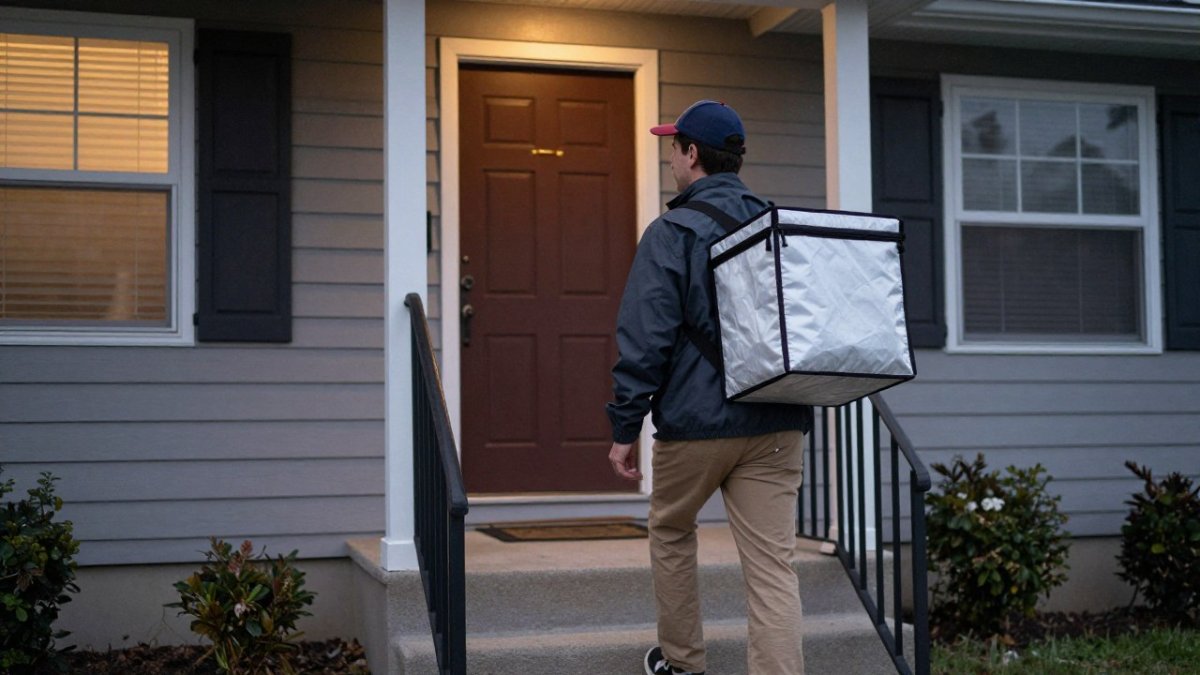
Delivery time can depend on the kitchen's workload, the distance to your address and how many orders the driver is already carrying. Dinner rushes, Friday nights and bad weather stretch every one of those variables at once. But the number on your screen is only part of the story, the bigger shift in the last few years is that tracking technology and communication expectations now shape how the wait actually feels, and most guides skip that entirely.
What the Estimate Actually Represents
An estimated arrival time is a window, not a promise to the minute. Most ordering systems generate it from a prep-time estimate plus a drive-time estimate, and both are recalculated as the order moves. Treat the low end as the earliest realistic arrival and the high end as the point where it is reasonable to check in.
How Tracking Changes the Wait
Modern GPS tracking and app notifications can change the experience of waiting in a few ways:
- Status stages replace a single countdown. You will typically see the order move from received to in the kitchen to out for delivery, and each stage resets your expectations. A status that sits on "in the kitchen" for 20 minutes is telling you something the countdown alone would hide.
- Driver location is approximate. The dot on the map is usually refreshed on an interval, not streamed in real time, so a driver who appears to be circling may simply be on a route the map has not updated yet.
- Notifications are the reliable signal. Push alerts for "your driver is on the way" and "your driver is nearby" are generally more accurate than staring at the map, because they fire off status changes rather than position pings.
Communication Expectations: When a Driver Should Call or Text
This is the part of the wait that customers and drivers most often get wrong. A reasonable standard is:
- Text, don't call, for arrival and drop-off instructions. A short message that the driver is nearby, plus where to leave the order, is faster and less disruptive than a phone call.
- Call only when there is a genuine blocker, a locked gate, a missing apartment number, a buzzer that does not work or no answer after a text and a knock.
- Stay silent during transit. A driver does not need to narrate the route, and a customer does not need to check in every five minutes. Both add distraction without adding information.
If you have a hard deadline, a shift change, a kids' bedtime, a meeting, put it in the order notes and order early. The note reaches the kitchen and the driver; a phone call after the fact usually cannot recover lost time.
Contactless Delivery: What to Expect at the Door
"Leave at door" is now a standard expectation, and it has its own protocol. Your side of the transaction is to make the drop-off spot findable: a clear address, a visible house number, a porch light on after dark and a note if the door is around the back. If you have pets or a gate, say so in the notes.
Pizza Delivery Tip Calculator: What to Pay and Why
Tipping is the part of the transaction most customers are unsure about, and it is the section where generic advice fails. Gratuity is customary for drivers, and it is a meaningful share of their take-home pay. The median annual wage for driver and sales workers was $38,770 according to the Bureau of Labor Statistics, which works out to roughly $18.64 an hour before tips (Bureau of Labor Statistics driver and sales worker wage data).
A Simple Dollar-Based Framework
Percentages break down on small orders. A 15% tip on a $22 pizza is $3.30, which does not reflect the fact that the driver made the same trip, waited the same amount of time and burned the same fuel as they would for a $60 order. Most experienced drivers and customers settle on a dollar-based floor plus a distance adjustment:
- Base tip: $4 to $5 for a standard order at a normal distance.
- Distance add-on: roughly $1 for every mile beyond about 5 miles from the store.
- Weather or difficulty add-on: $2 to $5 for heavy rain, snow, ice, a large apartment complex, a locked building or a long walk to the door.
A $30 order delivered two miles in clear weather lands at the base tip. A $30 order delivered eight miles in a downpour lands closer to $10 to $12. Neither number is a rule, they are anchors, and they track the actual effort far better than a flat percentage.
How Driver Pay Actually Works
A common pattern in the industry is that drivers are paid a modest hourly wage plus mileage reimbursement plus tips, and the mileage piece is frequently set below the real cost of operating a vehicle. The IRS standard mileage rate, the figure the federal government uses to estimate the cost of driving for business, is a useful benchmark for what a mile actually costs in fuel, maintenance, insurance and depreciation (IRS standard mileage rates).
Digital vs. Cash Tipping
Cash still works and is appreciated, but it is easy to forget and impossible to add after the fact. If you plan to tip in cash, set it aside before the driver arrives so the exchange stays quick. If you are unsure what to leave, the dollar framework above is a safer starting point than a percentage, and rounding up to the next dollar is a reasonable habit on small orders.
Pizza Delivery Etiquette for Customers
Good etiquette makes the driver's job faster and safer. Be reachable by phone, have payment ready, and meet the driver outside if the weather is bad and you can do so safely. If you requested contactless delivery, leave clear instructions for where the bag should go.
Keep the exchange brief and courteous. Drivers often carry several orders, and a short, polite interaction keeps the route moving for everyone.
What to Do If Your Pizza Order Goes Wrong
Mistakes happen, and how they are handled matters more than the mistake itself. Check your order as soon as the box opens, and contact the restaurant right away if something is missing or wrong.
For the full process and common questions, see our FAQ page, read How to Resolve Pizza Delivery Issues Fast? or contact us directly with feedback. A reader who wants to understand what happens next can start with the answers on the FAQ page.
Placing Your Next Wana Pizza Delivery Order
Now that you know what to expect, placing your next order is straightforward. Review the full menu and current prices before you order, choose your pizza, and note any dietary needs or delivery instructions. Our hand-tossed dough, signature sweet sauce and garlic butter crust are made fresh to order. Order now and see for yourself why Northwest Indiana keeps coming back.
Frequently Asked Questions
How much do you tip for a $20 pizza delivery?
A common starting point is 15 to 20 percent of the pre-tax order subtotal, so roughly $3 to $4 on a $20 order. Tip more for large or heavy orders, bad weather, or a long drive, and tip at least a few dollars on small orders since drivers often earn little per trip. Check the receipt first, since some platforms may already add a delivery fee or service charge.
Do I need to tip if there is a delivery fee?
Yes. A delivery fee does not replace a tip, since the two are typically separate charges. Check your receipt to confirm what is being charged.
What is the 2-hour food safety rule for pizza?
The general food safety guideline is that perishable food should not sit at room temperature for more than two hours. Above 90 degrees Fahrenheit, that window shrinks to one hour. For delivery, hot food should stay hot and cold food should stay cold during transit. If a pizza arrives lukewarm, let the restaurant know so it can review the order.
Is pizza delivery a hard job?
Pizza delivery can be physically and mentally demanding. Drivers spend long hours on the road, face traffic and weather, and handle tight delivery windows. Costs such as fuel, vehicle wear, and insurance come out of their earnings. Income for delivery drivers varies widely with tips, hours, and location. Treating drivers courteously makes the job easier for everyone.
What should I expect when ordering from a local shop like Wana Pizza?
Expect your pizza to be made fresh from hand-tossed dough. Delivery times can depend on order volume, distance, and weather, so ask for an estimate when you order. Customers in the Michigan City and Northwest Indiana area often ask about the sweet sauce and garlic butter crust, and special dietary requests can be noted on the order. For current menu items and prices, check the Wana Pizza website or call the restaurant directly.
What is the 30-minute pizza delivery rule?
The 30-minute rule was a delivery promise made by a national chain decades ago, and it is no longer an industry standard. Today most restaurants give an estimated window that depends on order volume, distance, and weather. Ask the restaurant for its current estimate when you order instead of relying on an old rule.
What should I do if my pizza order is wrong or incomplete?
Contact the restaurant as soon as you notice the problem, with your order number and a photo if the issue is visible. Be specific about what is wrong and stay courteous, since staff can resolve most issues faster when the conversation is calm. Keep your receipt and any app confirmation in case the restaurant needs them.
How do I know my pizza will arrive hot?
Order during a time when the kitchen is not overloaded and ask for an estimated delivery window. If your pizza arrives cold, let the restaurant know so it can review the order.