 How-to
How to Customize Pizza for Picky Eaters at Home
Quick Summary
Customizing pizza works for picky eaters because each person builds their own slice from a shared base. Start with toppings the child already eats, set up separate topping bowls, and introduce new toppings gradually one small step at a time.
- Start with three toppings your child already eats without fuss.
- Keep each topping in its own small bowl with a dedicated spoon or tongs.
- Introduce new toppings through four levels, from familiar toppings to a full portion.
- Stay at a level until the child is neutral rather than upset, then move up one step.
- Order a separate pizza for a child who needs a gluten-free crust rather than sharing one pie.
Table of Contents
- Why Customizing Pizza Works for Picky Eaters
- Step 1: Start With the Toppings Your Child Already Likes
- Step 2: Set Up Separate Topping Bowls for Pizza Night
- Step 3: Introduce New Toppings Gradually
- How to Order Pizza for Picky Eaters Without the Hassle
- Wana Pizza Menu Customization Options for Picky Eaters
- Troubleshooting Common Pizza Night Challenges
- Planning Your Next Family Pizza Night
- Frequently Asked Questions
Why Customizing Pizza Works for Picky Eaters
Last Updated: November 15, 2026
Picky eating is more common than many parents expect (Picky eating in children: causes and consequences). Many parents describe their children as picky eaters, and it can affect family meals (How Parents Describe Picky Eating and Its Impact on Family Meals: A Qualitative Analysis). Customizing pizza can be one of the simplest ways to turn a tense dinner into a fun one.
At Wana Pizza, we believe a pizza should work for every person at the table. Our hand-tossed dough and flavorful ingredients make it easy to customize each pizza. Here is how to set up a customized pizza night that works for even the pickiest eater.
- Kids get control over what goes on their own slice
- Parents avoid cooking several separate meals
- Everyone eats the same base, which feels familiar
Preferences vary. Preferences vary, and some people want light sauce while others want heavy sauce. Some do not want meat at all. Simple choices like these are why pizza can work well for families.
Step 1: Start With the Toppings Your Child Already Likes
Start with what your child already eats. A plain cheese pizza or one with a favorite topping is a safe place to begin. Familiar food lowers stress and builds confidence at the table.
Try this:
- List three toppings your child eats without fuss
- Build the first pizza with only those toppings
- Let your child pick the order of the slices
Once your child feels comfortable, add one small change at a time. Our Menu can help you find a simple combination to start from.
Step 2: Set Up Separate Topping Bowls for Pizza Night
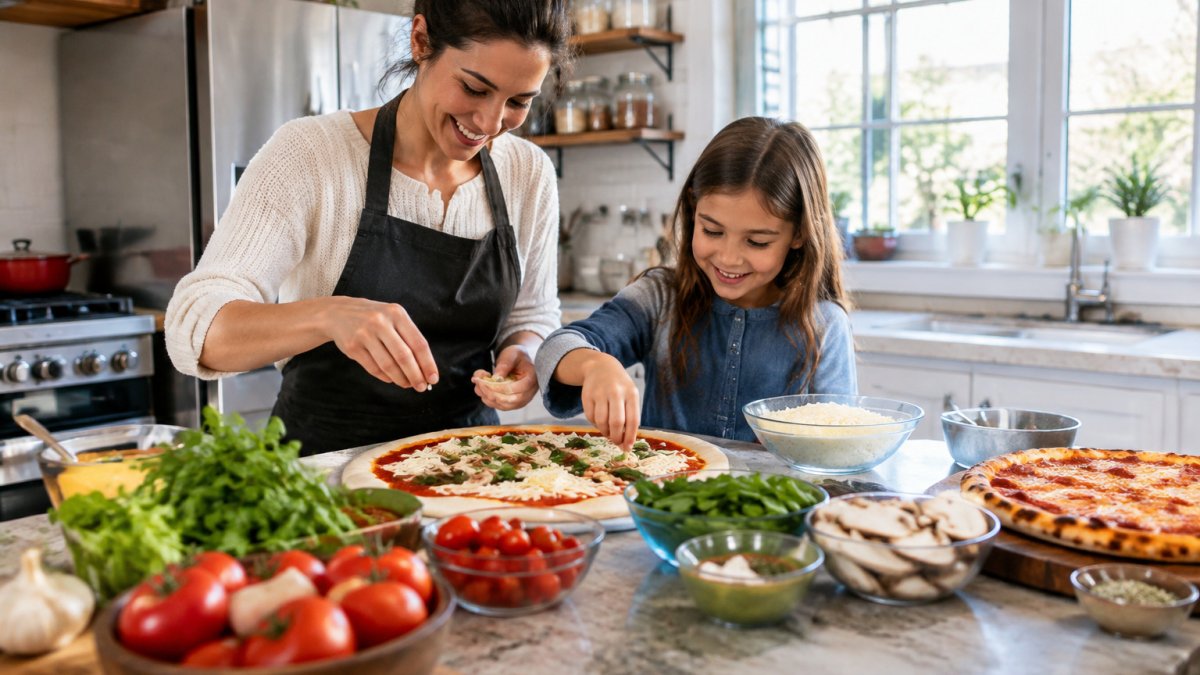
Separate bowls let each person build their own pizza. Keep each topping in its own small dish, so nothing touches another ingredient before it lands on the dough. This works well for kids who dislike sauce or certain textures.
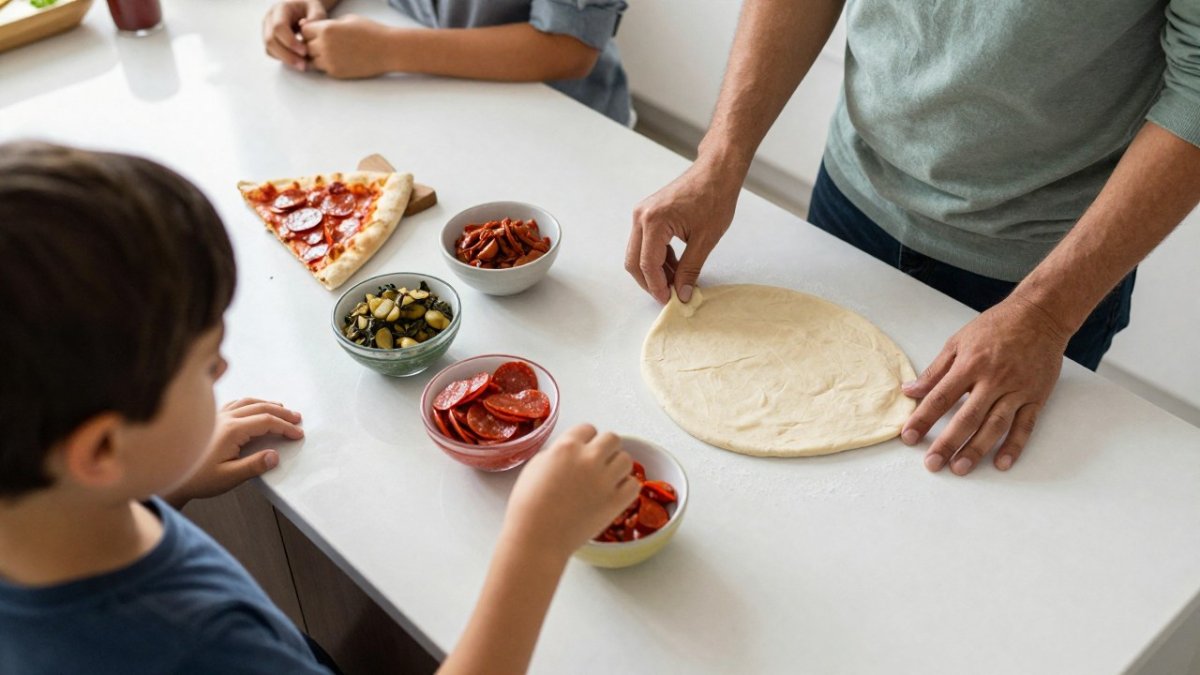
Set up your topping station:
- Small bowls for cheese, sausage, pepperoni, and mushrooms
- A separate bowl of sauce so each person can use as much or as little as they want
- A spoon or tongs for each bowl, so nothing gets mixed up
The dough is the foundation. Our dough is made fresh in our stores from unbleached flour, so the crust stays the same from slice to slice while the toppings change.
Step 3: Introduce New Toppings Gradually
Gradual exposure works best when it follows a predictable sequence rather than a random rotation of new foods. Most feeding practitioners describe a progression that moves from looking, to touching, to tasting, to eating a full portion, and pizza fits that ladder unusually well because the same base can carry each rung.
A four-level progression you can run on one pizza:
- Level 1, Same as always. Plain cheese or the one topping your child already accepts. No changes, no commentary. This is the baseline that keeps pizza night low-stress.
- Level 2, Adjacent swap. Change one attribute while keeping the rest identical: same cheese, same sauce amount, but swap pepperoni for a similar-shaped sliced meat, or swap one mild vegetable for another. The goal is a change the child can see coming.
- Level 3, Small addition on one slice. Put a pinch of the new topping on a single slice and leave the rest of the pizza untouched. The child decides whether to eat that slice, lick it, or move it to the side.
- Level 4, Half-and-half. Once a topping has been accepted on one slice across two or three pizza nights, offer it on half the pizza. Full-pizza acceptance is the last step, not the first.
Match the step to age and comfort level. A common pattern is that younger children and highly selective eaters need more repetitions at Levels 1 and 2 before a new topping is tolerated, while older kids who already help in the kitchen can often jump to Level 3 because they chose the change themselves. There is no fixed number of tries that guarantees acceptance; the useful rule is to stay at a level until the child is neutral rather than upset, then move up one step. Once a child can stay neutral through a small topping change, keeping the same patient, low-pressure approach at the table can help prevent mealtime battles, a principle also reflected in Tiny Charmers.
Mechanisms that make each step easier:
- Keep the sauce, cheese blend, and crust identical during a topping test so only one variable changes.
- Serve the new topping on the side first, so the child can add it themselves rather than finding it already baked in.
- Pair the new item with a preferred topping on the same slice, which most practitioners find lowers refusal compared with serving it alone.
- Re-offer the same topping on a later pizza night instead of switching to a different new food, since repeated neutral exposure is the mechanism, not novelty.
For ideas on what to try at each level, read our guide to unique pizza toppings to try in 2026.
Watch out: praising a child for "just trying it" can backfire if the child reads the praise as pressure; keep the tone neutral and let the pizza, not the encouragement, do the work.
The four levels below summarise the gradual progression, from familiar toppings to a full portion of a new one.
| Level | What to do | When to move on |
|---|---|---|
| 1. Same as always | Plain cheese or a topping already accepted | Stay until the child is relaxed |
| 2. Adjacent swap | Change one attribute, keep the rest identical | Child is neutral, not upset |
| 3. Small addition | Put a pinch on one slice only | Child accepts the slice |
| 4. Half-and-half | Offer the topping on half the pizza | Accepted over two or three nights |
How to Order Pizza for Picky Eaters Without the Hassle
Ordering takes the work out of pizza night. Pick a size that matches your group, then choose a base and let each person add one or two toppings. Smaller pizzas are often easier to share, so you can give everyone a slice they like.
Before you order, check the frequently asked questions for details on delivery and ordering.
Wana Pizza Menu Customization Options for Picky Eaters
Our menu offers specialty pizzas along with a build-your-own option. Each family member can choose toppings that suit their taste.
- Specialty pizzas for families who want a ready-made favorite
- Build-your-own pizzas for picky eaters who want control
You can see the options on the full menu. For current prices and ordering details, visit the Wana Pizza website.
Troubleshooting Common Pizza Night Challenges
Most pizza-night problems are not really about toppings. They are about texture, smell, temperature, appearance, or a mismatch between what was promised and what arrived on the plate. Organizing fixes by the sense involved is the angle most topping-focused guides skip, and it gives you a specific lever instead of a general "try again later."
Sensory-specific fixes:
- Texture. A child who rejects a topping may accept the same ingredient in a different form: diced instead of sliced, cooked until soft instead of crisp, or served raw on the side instead of baked into the cheese. Melted cheese that strings can be a problem on its own, so offer a slice with less cheese or a cooled slice where the cheese has set.
- Smell. Strong-smelling toppings such as onion, garlic, or certain cured meats can trigger refusal before the first bite. Keep those toppings in a covered bowl until assembly, or bake them on a separate small pizza so the main pie stays neutral.
- Temperature. Pizza straight from the oven can be too hot to handle and too intense in smell. Let slices rest for a few minutes and offer a room-temperature portion alongside a hot one.
- Visual appearance. A single unexpected color or shape can end the meal. Cut the pizza into smaller pieces, keep unfamiliar toppings on one clearly separated section, or let the child assemble the slice so nothing appears without warning.
Allergies, intolerances, and dietary restrictions. Customization has to account for safety, not just preference. If one child needs a gluten-free crust, order it as a separate pizza rather than assuming a shared pie is safe, and ask how the kitchen handles cross-contact with flour, cheese, and shared utensils.
Preparation and serving details that prevent problems:
- Portion individual pizzas smaller than you think you need; a child who is overwhelmed by a large slice often eats more when the piece is small.
- Bake individual or small pizzas on a preheated surface and watch them closely, since smaller pies finish faster than a full-size pizza and an overcooked edge can be a texture refusal on its own.
- Serve components separately when a child prefers them that way: crust, sauce, cheese, and toppings on the same plate but not assembled, so the child controls the combination.
- Keep a backup plain portion ready so a refused experiment does not turn into a skipped meal.
Common family situations:
- A child refuses everything new: return to the familiar build and skip the test for that night; the progression in Step 3 resumes later.
- One topping touches another: use separate bowls and a dedicated spoon or tongs for each topping, and assemble on individual plates rather than one shared pie.
- Too much sauce: let each person spoon their own sauce, or set aside a light-sauce portion before baking.
- A child is upset about how the pizza looks: cut it smaller, separate the sections, or let them rebuild the slice from the topping station.
- Two children want opposite toppings: build half-and-half pies or individual small pizzas rather than negotiating a single compromise topping.
- A preference changes mid-meal: keep the topping station available during the meal so a child can adjust a slice instead of abandoning it.
Keep pressure low. The goal is a pleasant meal and a safe one, not a full menu of new foods.
Planning Your Next Family Pizza Night
Plan ahead so you know how much to order. Count everyone at the table and decide how many pizzas each person will want. Use the party calculator to estimate the right amount for your guest count and party type.
Once you have your order, set up the topping bowls and let everyone build their own. A customized pizza night is a simple way to make dinner easier for the whole family.
Frequently Asked Questions
What are some easy and kid-friendly pizza toppings?
Plain cheese, pepperoni, mild sausage, diced ham, and sweet corn are among the most familiar choices for children. Kids who resist vegetables often accept mushrooms or diced tomatoes when they are mixed into a topping they already know. Start with two or three familiar toppings, then add one new option at a time on the side so the child can see it before deciding to try it.
How do you customize a pizza for someone with sensory issues?
Sensory-sensitive eaters often react to texture, smell, temperature, and appearance more than to flavor. Try a thinner crust with less sauce, pick toppings with a consistent texture, and keep ingredients from touching each other. Serve slices cool enough to avoid a strong first bite and let the child assemble their own pizza from separate bowls. If a topping causes distress, remove it without comment and offer a familiar option instead.
Can I order pizza for picky eaters from Wana Pizza?
Yes. When you place an order, you can ask for plain cheese or a half-and-half pie. Note any dietary restrictions in the order notes. For current menu options and pricing, check Wana Pizza's website, as prices depend on size, toppings, and delivery.
What should I do if my picky eater refuses the pizza?
Keep the meal low pressure. Offer a side of plain cheese or a familiar topping on the side and let your child eat what they are comfortable with. Avoid bribes or forced tasting, since pressure often increases resistance. Serving a small portion of a new topping alongside a food the child already likes gives repeated low-stakes exposure over time.